



Maxence Vincent lauréat d’une bourse ERC Starting Grant pour son projet MIMOSA
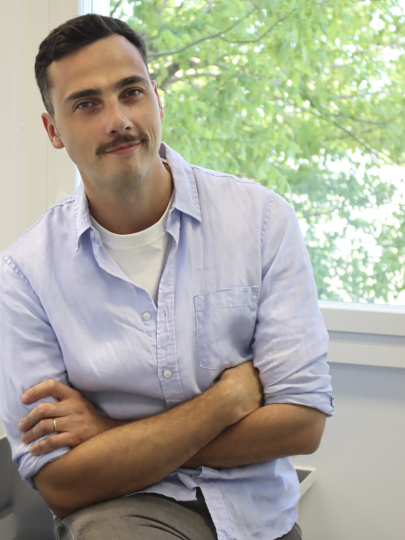
Retour sur l’obtention d’une bourse ERC Starting Grant (Horizon Europe) pour son projet MIMOSA par Maxence Vincent, chargé de recherche CNRS au sein de l’équipe « Réponses aux stress environnementaux » (dirigée par Benjamin Ezraty).
Maxence Vincent Awarded an ERC Starting Grant for the MIMOSA Project
A look back at the award of an ERC Starting Grant (Horizon Europe) to Maxence Vincent, CNRS research scientist in the « Bacterial Responses to Environmental Stresses » team (led by Benjamin Ezraty), for his MIMOSA project.
Comprendre la résistance bactérienne face à l’assaut oxydant de l’immunité
Lors d’une infection, les cellules immunitaires de première ligne (notamment les neutrophiles) déclenchent une « explosion oxydative », libérant des composés chimiques extrêmement réactifs pour neutraliser les bactéries pathogènes. Dotées d’une durée de vie de quelques fractions de seconde et d’un rayon d’action de quelques nanomètres à peine, ces molécules détruisent efficacement les pathogènes tout en préservant les tissus de l’hôte.
Toutefois, cette instabilité extrême rend leur étude presque impossible dans les conditions de laboratoire conventionnelles : les oxydants se dégradent ou réagissent immédiatement avec le milieu de culture. Les mécanismes moléculaires précis par lesquels ils endommagent les bactéries restent donc mal compris.
MIMOSA : la microfluidique au secours de l’imagerie à cellule unique
Le projet MIMOSA (Microfluidic Investigation of Myeloid-derived Oxidants in Salmonella Adaptation – ERC StG 101303713) vise à lever ce verrou méthodologique.
En associant microfluidique, photochimie et microscopie haute résolution de bactéries vivantes, Maxence et ses collaborateurs ont conçu une plateforme capable de synthétiser en flux continu ces oxydants instables et d’en contrôler l’exposition avec une précision spatio-temporelle inédite. En combinant cette technologie à la génétique et à l’évolution expérimentale, MIMOSA disséquera en temps réel comment Salmonella Typhimurium, bactérie responsable de sévères toxi-infections alimentaires, parvient à s’adapter et à survivre aux assauts oxydants du système immunitaire.
Un parcours à l’interface de la physique et de la microbiologie
Après un doctorat en microbiologie et un post-doctorat à l’Université d’Oxford (laboratoire du Pr Stephan Uphoff) où il s’est spécialisé dans la microscopie à l’échelle de la molécule unique et la microfluidique, Maxence Vincent a rejoint le LCB en 2022 grâce à une bourse européenne Marie Skłodowska-Curie. Recruté au CNRS en 2023, lauréat d’une ANR JCJC en 2024, cette bourse ERC vient couronner une trajectoire d’excellence et doter le laboratoire d’un projet pionnier pour la compréhension des interactions hôte-pathogène.
Deciphering Bacterial Survival Against Immune Oxidative Attacks
During an infection, first-line immune cells—particularly neutrophils—trigger an « oxidative burst », releasing highly reactive chemical species to neutralize invading pathogens. Because these molecules have an extremely short lifespan and diffuse only a few nanometers before decaying, they efficiently destroy bacteria while sparing surrounding host tissues.
However, this transient nature makes them notoriously difficult to study under standard laboratory conditions: the oxidants vanish almost instantly or react non-specifically with culture media. As a result, the precise molecular mechanisms by which they damage bacteria remain poorly understood.
MIMOSA: Microfluidics Meets Single-Cell Live Imaging
The MIMOSA project (Microfluidic Investigation of Myeloid-derived Oxidants in Salmonella Adaptation – ERC StG 101303713) aims to overcome this technical bottleneck.
By interfacing microfluidics, photochemistry, and high-resolution live-cell imaging, Maxence and his collaborators have developed a platform capable of generating unstable oxidants continuously on-chip, controlling their delivery with unprecedented spatiotemporal precision. By coupling this approach with bacterial genetics and experimental evolution, MIMOSA will dissect in real time how Salmonella Typhimurium—a major foodborne pathogen—senses, adapts to, and survives the oxidative assault deployed by the host immune system.
At the Crossroads of Physics and Microbiology
Following a PhD in microbiology and postdoctoral research at the University of Oxford (Prof. Stephan Uphoff’s lab), where he developed expertise in single-molecule microscopy and microfluidics, Maxence Vincent joined the LCB in 2022 through a Marie Skłodowska-Curie Postdoctoral Fellowship. Appointed as a CNRS permanent researcher in 2023 and awarded an ANR JCJC grant in 2024, this ERC Starting Grant highlights an outstanding track record and brings a pioneering research program on host-pathogen interactions to the laboratory.
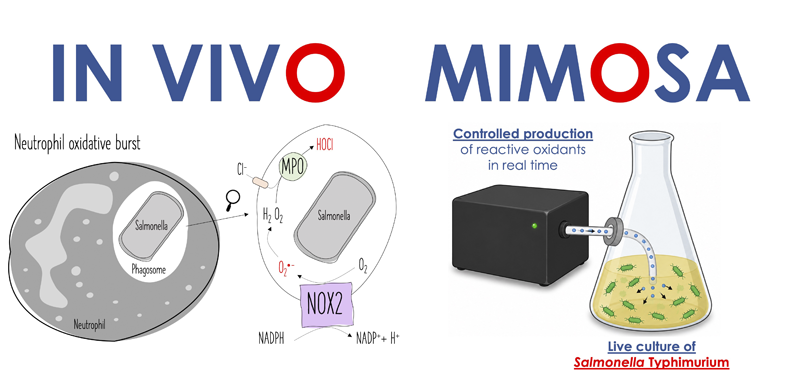
MIMOSA reproduit en culture l’explosion oxydative des neutrophiles face à Salmonella Typhimurium. Le système contrôle en temps réel la production d’oxydants réactifs afin d’étudier leur action antibactérienne dans des conditions physiologiques maîtrisées. ©Maxence Vincent
MIMOSA replicates in culture the oxidative burst of neutrophils against Salmonella Typhimurium. The system controls the production of reactive oxidants in real time to study their antibacterial activity under controlled physiological conditions. ©Maxence Vincent